Introduction
The following document has been prepared based upon all the available information and is largely a hypotheses, due to the fact that much of the information is hearsay and unsubstantiated. The basis in fact, however, is strong and several documents which re attached as appendices give a detailed summary of the information and reasoning behind this document.
Basic history of specific types of credit instruments
The issuance of bank (credit) instruments dates back to the early days of "banking" when private wealthy individuals used their capital to support various trade orientated ventures. Promissory Notes, Bills of Exchange, Bankers Acceptances and Letters of Credit have all been a part of daily "bank" business for many years.
There are three types of Letters of Credit which are issued on a daily basis. These are Documentary Letters of Credit, Standby Letters of Credit and Unconditional Letters of Credit or Surety Guarantees.
The issuance of a "Letter of Credit" usually takes place when a bank customer (Buyer) wishes to buy or acquire goods or services from a third party (Seller). The Buyer will cause his bank to issue a Letter of Credit which "guarantees" payment to the Seller via the Seller's bank conditional against certain documentary requirements. In other words, when the Seller via his bank represents certain documents to the Buyer's bank the payment will be made. These documentary requirements vary from transaction to transaction, however, the normal type of documents will usually comprise of:
- Invoice from Seller (usually in triplicate)
- Bill of Lading (from Shipper)
- certificate of Origin (from the Seller)
- Insurance documents (to cover goods in transit)
- Export Certificate (if goods are for export)
- Transfer of Ownership (from the Seller)
These documents effectively "guarantee" that the goods were "sold" and are "en route" to the Buyer. The Buyer is secure in the fact that he has "bought" the items or services and the Seller is secure in the fact that the Letter of Credit, which was delivered to him prior to the loading or release of the goods, will "guarantee" payment if he complies with the terms of the Letter of Credit.
This type of transaction takes place every day throughout the world, in every jurisdiction and without any fear that the issuing bank will not "honour" its obligation, providing that the bank if of an acceptable stature.
The Letter of Credit is issued i a manner which has been recognised by the Bank for International Settlements (B.I.S.) and the International Chamber of Commerce (I.C.C), and is subject to the uniform rules of collection for documentary credits (ICC 400, 1983).
This type of instrument is normally called a Documentary Letter of Credit ("DLC") and is always trade or transaction related, with an underlying sale of goods or services between the applicant (Buyer) and the Beneficiary (Seller).
During the evolution of the trade related Letters of Credit, a number of institutions began to issue Standby Letters of Credit )"SLC's"). These credit instruments were effectively a surety or guarantee that if the applicant (Buyer) failed to pay or perform under the terms of a transaction, the bank would take over the liability and pay the beneficiary (Seller).
In the United States banks are prohibited by regulation from providing formal guarantees and instead offer these instruments as a functional equivalent of a guarantee.
A conventional Standby Letter of Credit (CSLC) is an irrevocable obligation in the form of a Letter of Credit issued by a bank on behalf of its customer. If the bank's customer is unable to meet the terms and conditions of its contractual agreement with a third party, the issuing bank is obligated to pay the third party (as stipulated in the terms of the CSLC) on behalf of its customer. A CSLC can be primary (direct draw on the Bank) or secondary (available in the event of default by the customer to pay the underlying obligation). [Extracts from "recent Innovations in International Banking - April 1986 prepared by a study group established by the Central Banks of the Group of Ten Countries and published by the Bank for International Settlements.]
As these Standby Letters of Credit were effectively contingent liabilities based upon the potential formal default or technical default of the applicant, they are held "off balance" sheet in respect to the bank's accounting principles.
This type of Letter of Credit is commonly referred to in the market place as a short form format. This number is not found as a specific ICC 400 (1983) reference and is purported to be a federal court docket reference number which is related to a law suit involving such instrument, no details are available to the author.
Sunday, June 6, 2010

Wednesday, June 2, 2010
Trade Execution: What Every Investor Should Know
The graphic below shows your broker's options for executing your trade:
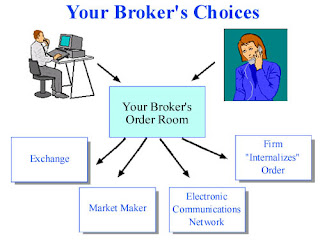
Your Broker Has a Duty of “Best Execution”
Many firms use automated systems to handle the orders they receive from their customers. In deciding how to execute orders, your broker has a duty to seek the best execution that is reasonably available for its customers' orders. That means your broker must evaluate the orders it receives from all customers in the aggregate and periodically assess which competing markets, market makers, or ECNs offer the most favorable terms of execution.
The opportunity for "price improvement" – which is the opportunity, but not the guarantee, for an order to be executed at a better price than what is currently quoted publicly – is an important factor a broker should consider in executing its customers' orders. Other factors include the speed and the likelihood of execution.
Here's an example of how price improvement can work: Let's say you enter a market order to sell 500 shares of a stock. The current quote is $20. Your broker may be able to send your order to a market or a market maker where your order would have the possibility of getting a price better than $20. If your order is executed at $20 1/16, you would receive $10,031.25 for the sale of your stock – $31.25 more than if your broker had only been able to get the current quote for you.
Of course, the additional time it takes some markets to execute orders may result in your getting a worse price than the current quote – especially in a fast-moving market. So, your broker is required to consider whether there is a trade-off between providing its customers' orders with the possibility – but not the guarantee – of better prices and the extra time it may take to do so.
You Have Options for Directing Trades
If for any reason you want to direct your trade to a particular exchange, market maker, or ECN, you may be able to call your broker and ask him or her to do this. But some brokers may charge for that service. Some brokers now offer active traders the ability to direct orders in Nasdaq stocks to the market maker or ECN of their choice.
In a recent speech, SEC Chairman Arthur Levitt emphasized that investors have the right to know where and how their firms execute their orders and what steps they take to assure best execution.
Ask your broker about the firm's policies on payment for order flow, internalization, or other routing practices – or look for that information in your new account agreement. You can also write to your broker to find out the nature and source of any payment for order flow it may have received for a particular order.
If you're comparing firms, ask each how often it gets price improvement on customers' orders. And then consider that information in deciding with which firm you will do business.
Trade Execution: What Every Investor Should Know (continue.....)
When you place an order to buy or sell stock, you might not think about where or how your broker will execute the trade. But where and how your order is executed can impact the overall costs of the transaction, including the price you pay for the stock. Here's what you should know about trade execution:
Trade Execution Isn’t Instantaneous
Many investors who trade through online brokerage accounts assume they have a direct connection to the securities markets. But they don't. When you push that enter key, your order is sent over the Internet to your broker—who in turn decides which market to send it to for execution. A similar process occurs when you call your broker to place a trade.
While trade execution is usually seamless and quick, it does take time. And prices can change quickly, especially in fast-moving markets. Because price quotes are only for a specific number of shares, investors may not always receive the price they saw on their screen or the price their broker quoted over the phone. By the time your order reaches the market, the price of the stock could be slightly – or very – different.
No SEC regulations require a trade to be executed within a set period of time. But if firms advertise their speed of execution, they must not exaggerate or fail to tell investors about the possibility of significant delays.
Your Broker Has Options for Executing Your Trade
Just as you have a choice of brokers, your broker generally has a choice of markets to execute your trade:
* For a stock that is listed on an exchange, such as the New York Stock Exchange (NYSE), your broker may direct the order to that exchange, to another exchange (such as a regional exchange), or to a firm called a "third market maker." A "third market maker" is a firm that stands ready to buy or sell a stock listed on an exchange at publicly quoted prices. As a way to attract orders from brokers, some regional exchanges or third market makers will pay your broker for routing your order to that exchange or market maker—perhaps a penny or more per share for your order. This is called "payment for order flow."
* For a stock that trades in an over-the-counter (OTC) market, such as the Nasdaq, your broker may send the order to a "Nasdaq market maker" in the stock. Many Nasdaq market makers also pay brokers for order flow.
* Your broker may route your order – especially a "limit order" – to an electronic communications network (ECN) that automatically matches buy and sell orders at specified prices. A "limit order" is an order to buy or sell a stock at a specific price.
* Your broker may decide to send your order to another division of your broker's firm to be filled out of the firm's own inventory. This is called "internalization". In this way, your broker's firm may make money on the "spread" – which is the difference between the purchase price and the sale price.
About Settling Trades In Three Days: Introducing T+3
Beginning on June 7, 1995, investors must settle their security transactions in three business days rather than five. This shortened settlement cycle is known as "T+3" - shorthand for "trade date plus three days."
This new rule means that when you buy securities, your payment must be received by your brokerage firm no later than three business days after the trade is executed. And if you sell securities, your brokerage firm must receive your securities certificate no later than three business days after you authorized the sale.
The U.S. Securities and Exchange Commission developed this brochure to address frequently asked questions about why the settlement cycle was shortened and to highlight issues you should consider in preparing for three-day settlement.
"Why the change?"
Unsettled trades pose risks to our financial markets, especially when market prices plunge and trading volumes soar. This happened when the stock market fell by over 500 points on October 19, 1987. In the hours and days following this drop, our financial markets were threatened by doubts about whether securities firms and investors hit by sizable losses would be able to pay for their transactions. By reducing the settlement cycle from five to three business days, the SEC has lessened the amount of money that needs to be collected at any one time, and strengthened our financial markets for times of stress.
"What security transactions are covered?"
Most security transactions, including stocks, bonds, municipal securities, mutual funds traded through a broker, and limited partnerships that trade on an exchange, must settle in three days. Government securities and options will continue to settle as they have in the past - one day following a purchase or sale.
Tips for Online Investing: What You Need to Know About Trading In Fast-Moving Markets
The price of some stocks, especially recent "hot" IPOs and high tech stocks, can soar and drop suddenly. In these fast markets when many investors want to trade at the same time and prices change quickly, delays can develop across the board. Executions and confirmations slow down, while reports of prices lag behind actual prices. In these markets, investors can suffer unexpected losses very quickly.
Investors trading over the Internet or online, who are used to instant access to their accounts and near instantaneous executions of their trades, especially need to understand how they can protect themselves in fast-moving markets.
You can limit your losses in fast-moving markets if you
* know what you are buying and the risks of your investment; and
* know how trading changes during fast markets and take additional steps to guard against the typical problems investors face in these markets.
Online trading is quick and easy, online investing takes time
With a click of mouse, you can buy and sell stocks from more than 100 online brokers offering executions as low as $5 per transaction. Although online trading saves investors time and money, it does not take the homework out of making investment decisions. You may be able to make a trade in a nanosecond, but making wise investment decisions takes time. Before you trade, know why you are buying or selling, and the risk of your investment.
Internet Fraud: How to Avoid Internet Investment Scams
Introduction
The Internet serves as an excellent tool for investors, allowing them to easily and inexpensively research investment opportunities. But the Internet is also an excellent tool for fraudsters. That's why you should always think twice before you invest your money in any opportunity you learn about through the Internet.
On October 28, 1998, the SEC announced charges against 44 stock promoters caught in a nationwide enforcement sweep to combat Internet fraud. These promoters failed to tell investors that more than 235 companies paid them millions of dollars in cash and shares in exchange for touting their stock on the Internet.
Not only did they lie about their own independence, some of them lied about the companies they featured, then took advantage of any quick spike in price to sell their shares for a fast and easy profit," said SEC Director of Enforcement Richard H. Walker.
This alert tells you how to spot different types of Internet fraud, what the SEC is doing to fight Internet investment scams, and how to use the Internet to invest wisely.
Navigating the Frontier: Where the Frauds Are
The Internet allows individuals or companies to communicate with a large audience without spending a lot of time, effort, or money. Anyone can reach tens of thousands of people by building an Internet web site, posting a message on an online bulletin board, entering a discussion in a live "chat" room, or sending mass e-mails. It's easy for fraudsters to make their messages look real and credible. But it's nearly impossible for investors to tell the difference between fact and fiction.
Online Investment Newsletters
Hundreds of online investment newsletters have appeared on the Internet in recent years. Many offer investors seemingly unbiased information free of charge about featured companies or recommending "stock picks of the month." While legitimate online newsletters can help investors gather valuable information, some online newsletters are tools for fraud.
Some companies pay the people who write online newsletters cash or securities to "tout" or recommend their stocks. While this isn't illegal, the federal securities laws require the newsletters to disclose who paid them, the amount, and the type of payment. But many fraudsters fail to do so. Instead, they'll lie about the payments they received, their independence, their so-called research, and their track records. Their newsletters masquerade as sources of unbiased information, when in fact they stand to profit handsomely if they convince investors to buy or sell particular stocks.
Some online newsletters falsely claim to independently research the stocks they profile. Others spread false information or promote worthless stocks. The most notorious sometimes "scalp" the stocks they hype, driving up the price of the stock with their baseless recommendations and then selling their own holdings at high prices and high profits. To learn how to separate the good from the bad, read our tips for checking out newsletters.
Bulletin Boards
Online bulletin boards – whether newsgroups, usenet, or web-based bulletin boards – have become an increasingly popular forum for investors to share information. Bulletin boards typically feature "threads" made up of numerous messages on various investment opportunities.
While some messages may be true, many turn out to be bogus – or even scams. Fraudsters often pump up a company or pretend to reveal "inside" information about upcoming announcements, new products, or lucrative contracts.
Also, you never know for certain who you're dealing with – or whether they're credible – because many bulletin boards allow users to hide their identity behind multiple aliases. People claiming to be unbiased observers who've carefully researched the company may actually be company insiders, large shareholders, or paid promoters. A single person can easily create the illusion of widespread interest in a small, thinly-traded stock by posting a series of messages under various aliases.
E-mail Spams
Because "spam" – junk e-mail – is so cheap and easy to create, fraudsters increasingly use it to find investors for bogus investment schemes or to spread false information about a company. Spam allows the unscrupulous to target many more potential investors than cold calling or mass mailing. Using a bulk e-mail program, spammers can send personalized messages to thousands and even millions of Internet users at a time.
How to Use the Internet to Invest Wisely
If you want to invest wisely and steer clear of frauds, you must get the facts. Never, ever, make an investment based solely on what you read in an online newsletter or bulletin board posting, especially if the investment involves a small, thinly-traded company that isn't well known.
What are investment advisers?
What is an investment adviser?
Investment advisers are in the business of giving advice about securities to clients. For instance, if they receive compensation for giving advice to a specific person on investing in stocks, bonds, or mutual funds, they are investment advisers. Some investment advisers manage portfolios of securities.
What is the difference between an investment adviser and a financial planner?
Most financial planners are investment advisers, but not all investment advisers are financial planners. Some financial planners assess every aspect of your financial life-including saving, investments, insurance, taxes, retirement, and estate planning-and help you develop a detailed strategy or financial plan for meeting all your financial goals.
Others call themselves financial planners, but they may only be able to recommend that you invest in a narrow range of products, and sometimes products that aren't securities.
Before you hire any financial professional, you should know exactly what services you need, what services the professional can deliver, any limitations on what they can recommend, what services you're paying for, how much those services cost, and how the adviser or planner gets paid.
Subscribe to:
Posts (Atom)